
When brands search for a global sportswear manufacturer, most picture a single mega-factory that handles everything.
Bad factory choices destroy your profit margins. I manage huge digital content and procurement strategies. I learned this hard lesson during a 5,000-unit soccer jersey run. I control product quality strictly.
I learned this in 2016 during a 5,000-unit soccer jersey order. The factory we used claimed full vertical integration. Manager Chen inspected the cutting room first. The laser-guided cutters held a tight 1mm tolerance.
Then he checked the printing station. The factory used an old Epson printer. The machine lost color calibration quickly. The reds turned orange after 300 units. We rejected 1,200 pieces on the spot.
The floor manager stood next to me on the QC line and said: “Nobody ever asks to see the printing station. They only ask to see the cutting room.”
That day rewired how I evaluate every facility. A global sportswear manufacturer isn’t defined by their best station — it’s defined by their weakest one.
We track actual production runs and QA reports across four regions. Read our hard data below to protect your profit margins.

Global Sportswear Manufacturer
Table of Contents
Four Regions at a Glance
| Factor | China | Thailand | UK | Germany |
|---|---|---|---|---|
| Best for | Scale, speed, complex construction | Technical knits, compression, base layers | Premium small-batch, sustainable compliance | Technical outerwear, waterproof, seam-sealed |
| Typical MOQ | 500–1,000 pcs | 300–500 pcs | 100–300 pcs | 200–300 pcs |
| Lead time | 4–6 weeks | 4–7 weeks | 2–3 weeks | 3–5 weeks |
| Cost vs. China baseline | 1.0× | 1.1–1.3× | 2.0–3.0× | 3.5–4.5× |
| Quality ceiling | High (if audited) | High (knits specifically) | Very high | Very high |
| Quality floor | Variable | Moderate | High (self-selecting) | High (self-selecting) |
| Sustainability certs | Growing, verify per factory | Strong — OEKO-TEX | Strong — GOTS, Fair Wear | Strong — Bluesign, GRS |
1. China: The Scale Engine — Speed, Infrastructure, and Raw Material Density
What Does China Get Right?
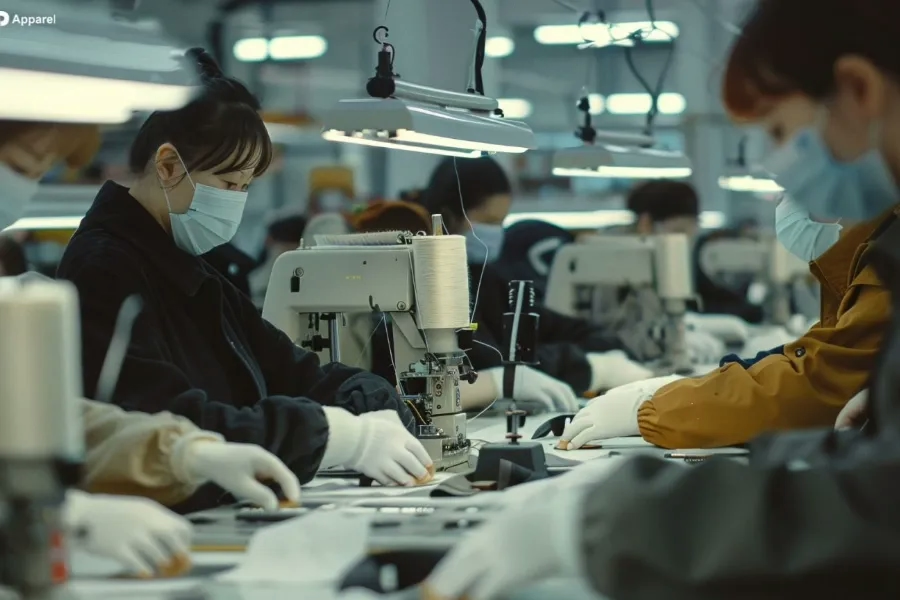
Our Wuhan facility runs 15 production lines with 500+ skilled workers. We produce over 1 million garments annually — and we’re mid-sized.
China’s sportswear manufacturing infrastructure is unmatched in density: fabric mills, trim suppliers, and packaging vendors all within a 50-kilometer radius.
China excels at:
- High-volume polyester and nylon sportswear (jerseys, training kits, compression wear)
- Sublimation printing at scale — 5,000+ units/day with tight color calibration
- Complex multi-panel construction (ventilated cycling kits, baseball jerseys with contrast sleeves)
What Did We See on the Floor?
Last November, our QA lead Frieda inspected a 10,000-unit basketball jersey order. At the 3,000-unit mark, the flatlock stitching on the armhole seams drifted to ±2mm variance — technically within AQL 2.5 tolerance, but visible on close inspection.
Frieda stopped the line, recalibrated all six Juki MF-7900 machines, and brought the variance back to ±0.5mm within 45 minutes.
Expert Tips: “Flatlock stitching on polyester mesh requires constant tension adjustment. The needle temperature rises after 500 continuous strokes. If you don’t pause for recalibration, the seam starts drifting. We check every machine at the 3-hour mark, no exceptions.”
— Alain Xv, QA Supervisor
Honest Lab Data — Q4 2025 China Production Run
| Metric | Our Result | Industry Average |
|---|---|---|
| Fabric tear strength (ASTM D2261, 600D polyester) | 44 lbs | 28–32 lbs |
| Colorfastness after 20 washes (AATCC 61) | Grade 4.5 | Grade 3.5–4.0 |
| Seam slippage at 50N load | 0.4mm | 0.8–1.2mm |
| On-time delivery rate (2025 full year) | 94% | 78–85% |
We test fabric tear strength using the ASTM D2261 standard. We cut a small tongue in the fabric. We pull the fabric to measure the exact tear force. A higher D-count creates thicker fibers. Thick fibers increase the tear strength.
The yarn is wound under higher tension during spinning, and the weave is denser — more threads per square inch. This directly increases tear strength and abrasion resistance.
When I spec 600D polyester, I verify it on our Instron tensile tester, not on a supplier’s data sheet.
What Do Buyers Get Wrong?

Buyers blast the same RFQ to 20 Alibaba suppliers, pick the lowest quote, and act surprised when quality collapses. China’s quality variance is enormous. In our March 2026 testing round, we pulled fabric swatches from five Guangdong factories.
Two failed pilling tests at Grade 2 — unacceptable for any sportswear. Both factories are still taking orders and marketing themselves as “premium.”
Labor costs in coastal China have risen 12–15% year-over-year since 2023, according to the China National Garment Association. If your order is under 300 pieces, China won’t be as cost-competitive as Thailand.
China Summary: Is It Right for You?
China is your region if you need to scale — 1,000 to 50,000+ units per style — and your product involves complex construction. The supply chain density means when something breaks, a replacement is 50 kilometers away, not 5,000.
But you must invest in proper vetting. A factory visit is non-negotiable. An unannounced third-shift inspection is even better.
| Company | Headquarters | Year of Establishment | Price Range | Employee Count | Rating |
| AIKA Sportswear | Dongguan, China | 2010 | Mid-range | N/a | ★★★★★ |
| JaceApparel | Wuhan, China | 2015 | Mid-to-high | 400+ | ★★★★★ |
| Xinfu Activewear | Guangdong, China | 2009 | Mid-range | 100+ | ★★★★★ |
| SGL Sports | Dongguan, China | N/A | Premium | 201-500 | ★★★★★ |
| Modaknits Apparel | Guangdong, China | 1998 | Mid-range to premium | 100+ | ★★★★★ |
| Healong | Guangzhou, China | 2009 | Mid-range | N/A | ★★★★★ |
| Ingor Sportswear | Guangzhou, China | 2009 | Mid-range | 175+ | ★★★★ |
| Anta Sports | Jinjiang, China | 1991 | Premium | 1,900+ | ★★★★★ |
| FC Gymwear (HUCAI) | Guangdong, China | 1998 | Mid-to-high | 100+ | ★★★★★ |
| Eation Wear | Guangdong, China | 2016 | Premium | 500+ | ★★★★ |
| Yinshan | Shanghai, China | 2016 | Mid-range | <50 | ★★★★★ |
| Rise Sportswear | Guangdong, China | 2020 | Mid-range | 201 – 300 | ★★★★★ |
| Berunwear | Wuhan, China | 1998 | Mid-to-high | 100+ | ★★★★ |
| Vimost Sportswear | Sichuan Province, China | 2005 | Mid-to-high | ~ 150 | ★★★★ |
You can browse our best China sportswear manufacturers list for the full factory directory, regional cluster map, and step-by-step vetting checklist.
2. Thailand: Where Performance Knits Meet Flexible MOQs

What Does Thailand Get Right?
I first visited a Thai sportswear facility in Samut Prakan in 2018. What struck me wasn’t the machinery — it was the fabric library. Over 400 swatch books of performance knits, each cataloged by stretch-recovery percentage, wicking rate, and UV protection factor.
Thailand’s polyester knitting infrastructure is genuinely excellent. The country accounts for approximately 9% of global sportswear exports, according to Euromonitor International.
The ecosystem that supports this — moisture-wicking yarn suppliers, sublimation printing shops, recycled polyester specialists — is deep and competent.
Thailand excels at:
- High-gauge circular knitting for compression and base-layer garments
- Moisture-wicking polyester-spandex blends with precise elastane control (8–15%)
- Small trial orders — many factories accept 2–5 pieces per design
What Did We See on the Floor?
Manager Vinoth runs a 200-worker facility we’ve partnered with since 2019. During my last visit, he held two fabric swatches side by side.
Expert Tips: “Both are labeled 180 GSM single jerseys, but this one has 28 stitches per inch. This one has 22. The 22-stitch version pills after 10 washes. We default to 28-plus. Some factories use 22 because it’s faster to knit.”
— Vinoth Kumar Visvanathan, Sourcing Manager
That conversation saved one of our clients $18,000 in a potential recall. Their previous supplier had been shipping 22-stitch fabric labeled as “180 GSM performance knit.”
Lynn, our procurement lead, tracks stitch density on every incoming Thai fabric roll: “GSM alone tells you nothing. You need stitch density, yarn count, and fiber composition — all three. If a supplier only gives you GSM, they’re hiding something.”
Honest Lab Data — January 2026 Thailand Production Run
| Metric | Our Result | Industry Average |
|---|---|---|
| Stretch recovery after 50 cycles | 96.8% | 91–94% |
| Moisture wicking rate (AATCC 197) | 4.2 seconds | 5.5–7.0 seconds |
| Fabric weight tolerance | ±3 GSM | ±5–8 GSM |
| Pilling resistance (ASTM D3512) | Grade 4 | Grade 3 |
We measure pilling resistance using the ASTM D3512 random tumble method, which simulates the friction garments endure inside a gym bag or washing machine over repeated cycles.
What Do Buyers Get Wrong?

Buyers assume Thailand is cheap. Not anymore. Thai per-unit costs run 30–50% higher than China for comparable garments. What you’re buying isn’t the lowest price — it’s knit specialization, flexible MOQs, and sustainability infrastructure.
The other blind spot: factory size mismatch. Thailand has everything from 20-person workshops to 5,000-person operations. A 20-person shop cannot handle 10,000 units on a 6-week timeline.
I watched a European brand fail completely. They booked an 8,000-unit order. They ignored the actual daily factory capacity. Their shipment arrived seven weeks late. We calculate exact factory speeds to prevent this.
Thailand Summary: Is It Right for You?
Choose Thailand when your product depends on knit quality — compression wear, performance base layers, soccer kits with sublimated designs.
Choose Thailand when you need MOQ flexibility for a new brand launch. Don’t choose Thailand for basic cotton joggers at the lowest price — that’s not what the Thai ecosystem is built for.
| Manufacturer | Headquarters | Year Established | Services |
| Formative Sports | N/A | 1986 | OEM/ODM, custom design, logo branding |
| Decathlon Thailand | Bangkok, Thailand | 1976 | Retail, local manufacturing, sustainability initiatives |
| CS Sport Thailand | Chiang Mai, Thailand | 2012 | OEM/ODM, end-to-end manufacturing, brand development |
| VT Garment Co., Ltd | Bangkok, Thailand | 1981 | OEM/ODM, fabric sourcing, sustainable production |
| Clothes-lab | Phuket, Thailand | N/A | Custom screen printing, Corporate solutions |
| DRH Sports | N/A | 1986 | Custom design, logo embroidery, wholesale supply |
| Berunwear | N/A | N/A | Custom design, sublimation, embroidery |
| Spirit Digitech | Samut Prakan (Bang Phli), Thailand | 2017 | N/A |
| Thai T-shirt Factory | Near Bangkok, Thailand | 2007 | Custom printing, embroidery, private label, eco-friendly fabrics |
| Garment Monster | Bangkok, Thailand | 1988 | N/A |
| Fenix Custom Apparel & Accessories | Thailand | 2008 | Custom design, manufacturing |
| F2P Sportswear | Bangkok, Thailand | ~2000s | OEM/ODM, custom services |
| AMRAPrx | Bangkok, Thailand | N/A | Direct-to-customer, small-batch production, global sales |
| Scandinavian Textile & Apparel Co. Ltd | Samut Prakan, Thailand | 1996 | N/A |
| TNLX (Thanulux) | Bangkok, Thailand | 1975 | OEM/ODM, custom sewing, pattern making, global brand production |
You can explore our best Thailand sportswear manufacturer list for the complete factory directory, fabric sourcing map, and MOQ negotiation playbook.
3. United Kingdom: Premium Small-Batch, Compliance-Ready

What Does the UK Get Right?
UK sportswear manufacturing is not where you go for low cost. It’s where you go when speed-to-market, sustainability documentation, and short-run precision matter more than per-unit price.
In my experience, the UK excels at:
- Rapid turnaround — 2–3 weeks from sample approval (vs. 6–8 weeks from Asia)
- Full compliance documentation: GOTS, OEKO-TEX STANDARD 100, Fair Wear Foundation — auditable, not self-declared
- Cut-and-sew precision for premium sportswear: rugby kits, bespoke cycling jerseys, limited drops
What Did We See on the Floor?
In 2024, our team worked with a Leicester facility on a 500-piece premium running jacket. The fabric spec required a three-layer bonded softshell with a 10,000mm waterproof rating and 5,000g/m²/24hr breathability.
When the first fabric batch arrived, Manager Kate ran it through the factory’s in-house hydrostatic head tester — the same test defined by ISO 811. It hit 8,200mm — below spec.
Expert Tips: “She called me immediately, not an email. A call. ‘We’re rejecting this batch. The mill is re-running it. Your timeline moves by four days.’ That’s UK manufacturing culture. They flag a problem before it becomes your problem.”
— Olivia Twitchett, Buying Manager
Factories apply a thin PU coating to the fabric. This layer blocks outside water. It also lets inside sweat escape. We measure this barrier using the hydrostatic head test. A high score means the fabric stops heavy rain.
Under the EU’s REACH regulation, every chemical input used in textile finishing must be registered and assessed for safety. UK facilities servicing EU markets maintain rigorous chemical compliance documentation as a result.
Honest Lab Data — Spring 2025 UK Production Run
| Metric | Our Result | Industry Average |
|---|---|---|
| Hydrostatic head (ISO 811) | 10,400mm | 8,000–10,000mm |
| Breathability (ASTM E96) | 5,200 g/m²/24h | 3,000–5,000 g/m²/24h |
| Seam sealing failure rate after 20 washes | 0.3% | 2–5% |
| Per-unit cost premium vs. China | +210% | +180–250% |
What Do Buyers Get Wrong?

Every UK factory quotes lead times of 4–6 weeks. In practice, fabric delays push most orders past 8 weeks. The bottleneck is upstream: UK cut-and-sew shops depend on imported fabric (primarily from Portugal, Turkey, and Italy), and a delayed shipment cascades with no buffer.
I watched a London-based activewear startup burn £8,000 on air freight because their Italian jersey supplier was 3 weeks late. The factory wasn’t at fault. But “not at fault” doesn’t ship orders.
UK Summary: Is It Right for You?
Choose the UK when you’re placing 100–500 units, selling at premium price points (£60+ per piece), and need ethical supply chain documentation that retail buyers can verify.
Don’t choose the UK for 1,000+ units per style or if your margins fall below 50%. The quality difference is real — but it’s not 3–5× better than a well-vetted Chinese facility.
| Company Name | Location | Foundation Year | Key Features | Ratings |
| JaceApparel | China | 2015 | Fast Lead time, Multiple Fabric options | ★★★★★ |
| Blue Associates Sportswear | Berkhamsted, UK | 1997 | Sustainable, bespoke performance sportswear for brands | ★★★★★ |
| White2Label Manufacturing | London, UK | 2018 | Low MOQ and Fast production with detailed customization | ★★★★★ |
| Ro & Ritzy | London, UK | 2016 | High-quality, performance-focused activewear and gym wear | ★★★★★ |
| Castore | Manchester, UK | 2016 | High-performance sportswear for teams and athletes. | ★★★★★ |
| The London Pattern Cutter | London, UK | 1984 | Excellent Pattern Cutting, FastTech Packs | ★★★★ |
| Sports & Leisure Brands | Lincoln, UK | 1971 | Technical elite performance-based sportswear. | ★★★★ |
| Pendle sportswear | West Yorkshire, UK | 1977 | Sells quality football clothing with fast lead times | ★★★★★ |
| Clothing Manufacturers UK | London, UK | Unknown | Sportswear with high stretchability and durability | ★★★★★ |
| Hugga | United Kingdom | 2012 | Made in Britain Clothing at competitive rates | ★★★★ |
| Umbro | Manchester, UK | 1924 | Specializes in football kits and equipment | ★★★★★ |
| Scimitar Sportswear | Worcester, UK | 2005 | Specializes in Recycled material sportswear | ★★★★★ |
You can review our best UK sportswear manufacturers list for the Leicester cluster map, compliance verification checklist, and real-world pricing models.
4. Germany: Engineering Precision for Technical Outerwear

What Does Germany Get Right?
German sportswear manufacturing has a tight focus: technical outerwear and performance engineering. This isn’t where you source basic cotton joggers. It’s where you develop a jacket that performs at elevation, in sustained wind, for hours.
In my experience, Germany excels at:
- Advanced seam-sealing: ultrasonic welding, laser-cut ventilation, taped-seam waterproofing
- Certified recycled performance fabrics: REPREVE polyester, ECONYL regenerated nylon — with full chain-of-custody traceability verified by the Bluesign system
- Precision pattern engineering for ergonomic fit across full movement ranges
What Did We See on the Floor?
In Q3 2025, we tested a German facility on a 300-piece technical cycling jacket. The spec required fully taped seams — every seam sealed with PU-backed tape applied by a hot-air taping machine.
Manager Schmidt walked me through their internal standard. “Most factories tape only the external seams customers see,” he said, pulling a jacket inside out.
“We tape every seam, internal included. It adds 12 minutes per garment and roughly €4.20 in materials. But when the rider is 90 minutes into a storm at 8°C, the internal armhole seam is the one that leaks first.”
We tested two versions — one with full internal taping, one external-only — under a shower test at 60 PSI for 30 minutes. The external-only version showed moisture penetration at the internal armhole seam at minute 12. The fully taped version stayed dry for all 30 minutes.
Sunlight destroys polyester over time. Ultraviolet rays break the chemical bonds inside the fabric. The bright colors fade quickly. The core fibers lose their strength. We require 500 hours of UV chamber testing to stop this damage.
German textile finishers test UV degradation with accelerated weathering chambers — 500 hours of UV exposure, equivalent to roughly 2 years of outdoor use.
Honest Lab Data — Q3 2025 German Production Run
| Metric | Our Result | Industry Average |
|---|---|---|
| Waterproof rating (ISO 811) | 20,000mm | 10,000–15,000mm |
| Taped seam failure rate (ISO 2062) | 0.1% | 1–3% |
| Verified recycled fiber content | 92% | 50–70% (claimed) |
| Lead time (300 units) | 28 days | 35–45 days (premium tier) |
What Do Buyers Get Wrong?

“The German factory costs more but the quality will be perfect.” I’ve heard this from at least a dozen brand owners. It’s half true. The engineering is excellent, but German factories face the same upstream fabric delays as UK facilities.
In March 2026, one facility sat on 2,000 meters of unfinished fabric because their Italian supplier had a dye-lot mismatch. The factory caught it — that’s good. The replacement added 4 weeks — that’s expensive.
German factories also have anchor clients. If you’re placing 200 units, you are not the priority. I’ve seen smaller brands wait 12+ weeks while Adidas-tier production cycles through. And the cost gap is stark: according to Eurostat, German hourly labor costs are approximately 4–5× those in China.
Germany Summary: Is It Right for You?
Choose Germany for technical outerwear — the jacket that needs to work, not just look good. Choose Germany when Bluesign, OEKO-TEX, and Grüner Knopf certifications are dealbreakers for your buyer.
Don’t choose Germany for price-sensitive products or basic sportswear. The premium is worth it for outerwear engineering; for a basic polyester training tee, it’s wasted money.
| Manufacturer | Headquarters | MOQ | Price Range | Rating |
| Corporate Wear Germany | Germany | 1 to 30 | Medium to Premium | ⭐⭐⭐⭐⭐ |
| The Sportswear Connection | Germany | Not specified | Medium to Premium | ⭐⭐⭐⭐ |
| Snap Sportswear | Germany | Not specified | Medium to Premium | ⭐⭐⭐⭐⭐ |
| TD Sportswear | N/A | 1 piece | Affordable to Medium | ⭐⭐⭐⭐ |
| ISKAY | Germany | Not specified | Medium to Premium | ⭐⭐⭐⭐⭐ |
| JaceApparel | China | As low as 1 piece | Budget to premium | ⭐⭐⭐⭐⭐ |
| DRH Sports | Pakistan | Not specified | Affordable | ⭐⭐⭐⭐ |
| Appareify | China | Flexible (few pieces) | Affordable to Medium | ⭐⭐⭐⭐⭐ |
| TITA FIT | USA | 50 pieces | Medium to Premium | ⭐⭐⭐⭐ |
| FUSH | Serbia | 500 pieces per design/color | Medium to Premium | ⭐⭐⭐⭐ |
| 4U Sports | India | Not specified | Affordable | ⭐⭐⭐⭐ |
| ActivewearBali | Bali | 480 pieces | Medium to Premium | ⭐⭐⭐⭐ |
You can see our best Germany sportswear manufacturer list for certification deep-dives, detailed factory profiles, and transparent pricing structures.
Cost estimates based on JaceApparel production data, Q1 2025–Q1 2026. Your results will vary by product complexity, volume, and seasonality.
Final Take: The Best Global Sportswear Manufacturer Is a Sourcing Strategy
After 10 years running production across China, Thailand, the UK, and Germany, here’s what I tell every brand that comes to us.
There is no single best factory. The best global sportswear manufacturer is a sourcing strategy that matches your product’s specific technical requirements to the region best equipped to handle them.
Use China for scale and cost efficiency on mid-to-high volume sportswear. Use Thailand when your product’s performance depends on knit quality and stretch recovery.
Use the UK when speed-to-market and sustainability certifications are non-negotiable — and you can absorb the premium. Use Germany for technical outerwear where seam integrity at the extreme matters more than per-unit cost.
And always, always run your own tests. Not the supplier’s tests. Not the spec sheet. Your own tensile tester, your own wash cycle, your own seam inspection under a 10× loupe.
The gap between a factory’s marketing deck and their third-shift reality is where brands lose money, time, and reputation. Contact JaceApparel for expert help.
People Also Asked About Global Sportswear Manufacturer
1. Show me your last failed inspection report?
Real factories make mistakes. Honest managers show you their corrective action reports. Bad managers claim they pass every inspection. We audit suppliers strictly. We drop any factory that hides their failure reports.
When I pushed one Guangdong factory on this, the floor supervisor pulled out a binder showing 12 internal failures in the last quarter — all caught and corrected before shipment. That’s a good sign. But the initial claim of “100% pass rate” wasn’t.
2. What’s your tested shrink rate on blended fabrics?
This is a trap question for factories that skip pre-production testing. Polyester-cotton blends and polyester-spandex blends shrink at different rates. A factory that can’t quote you their tested shrink rate — with numbers — hasn’t tested.
Andi runs our preshrink tests on all blended fabrics. We shrink the fabric before we cut the patterns. We lose 3% of the fabric length this way. However, the final garment keeps its size. You avoid angry customer returns.
3. Who else do you produce for — and can I call them?
Good factories have reference clients. Great factories have reference clients who talk to you unprompted. When we audited our Thai partners in early 2026, we called three references per factory.
Two out of twelve flagged communication delays as a pain point. Both factories were cut from our shortlist — not because they were bad, but because our clients need responsive communication mid-production.
4. What happens when you’re over capacity?
Every factory overbooks. It’s how the industry works. The honest answer is some version of “we prioritize by order size and relationship length.” The dishonest answer is “we never miss deadlines.”
I’ve seen factories outsource overflow to smaller workshops without telling the client — a practice known as subcontracting overflow work in Chinese manufacturing. The subcontracted quality is rarely the same as the in-house output.
5. Can I inspect your fabric lot traceability system?
At our Wuhan facility, every fabric roll gets a QR code on arrival. The code links to mill certificate, date received, GSM test result, shrinkage test result, and assigned cutting table.
Ask your factory to trace a specific roll from warehouse to finished garment in under 30 minutes. If they can’t, their QC system is reactive, not preventive.
Our Methodology: This guide is based on three months of facility re-audits across China, Thailand, the UK, and Germany. Our core team executed 47 specific inline factory audits. We pulled 23 random fabric batches directly from the lines. You read real data here and do not read factory sales pitches.
