
Most founders view swimwear purely as aesthetics. But different types of bikinis require unique technical briefs. In my experience running custom swimwear manufacturing, ignoring construction details destroys margins.
Bikinis represent a complex family of coverage and support profiles across tops and bottoms. JaceApparel spent two weeks testing silhouettes, documenting exact material specs, sewing challenges, and strict AQL 2.5 benchmarks to mitigate sampling risk.

Table of Contents
Overview of the 20 Types of Bikinis (Tops & Bottoms)
| Bikini Name | Coverage | Unique Feature |
| Triangle Bikini Top | Low | Classic triangular cups |
| Bandeau Bikini Top | Low–Medium | Strapless band design |
| Halter Neck Bikini Top | Medium | Neck support |
| Underwire Bikini Top | Medium | Wired bust shaping |
| Push-Up Bikini Top | Medium | Bust-enhancing |
| Bralette Bikini Top | Medium | Comfort bralette style |
| Crop Top Bikini | High | Sporty full coverage |
| One-Shoulder Bikini Top | Medium | Asymmetrical strap design |
| High-Neck Bikini Top | High | Athletic high neckline |
| Sport Bikini Top | Medium–High | Sports bra inspired |
| Classic Bikini Bottom | Medium | Simple versatile cut |
| Cheeky Bikini Bottom | Low | Booty-accentuating cut |
| Tie-Side Bikini Bottom | Low–Medium | Adjustable side ties |
| High-Waisted Bikini Bottom | High | Retro waist slimming |
| High-Leg Bikini Bottom | Low–Medium | Leg lengthening cut |
| Thong Bikini Bottom | Very Low | Minimal coverage back |
| Swim Shorts | High | Modest sport-friendly |
| Skirted Bikini Bottom | High | Skirt overlay design |
| Fold-Over Bikini Bottom | Medium–High | Foldable waistband style |
| Scrunchy Bikini Bottom | Low–Medium | Ruched backside detail |
10 Types of Bikini Tops
Let’s start from the TOP, shall we? These types of bikini tops are so in-demand. You can’t find European swimwear brands that don’t sell these.
1. Triangle Bikini Top
Triangle tops offer adjustable coverage. They are the safest baseline for your first capsule launch. Their minimal structure lets you swap prints across small batches to limit inventory risk.
Tie-tunnel symmetry ruins many designs. When we produced the Summer Bliss line, slipping elastic paths caused major fabric bunching, and we quickly trained our sewing team to fix this problem.
🚀 Actionable Insight: Stretch your proto-sample fully. If the seams sag, demand tighter elastic.
2. Bandeau Bikini Top

Bandeaus offer a clean fashion silhouette that minimizes tan lines. You must restrict your size range during early planning, as strapless designs lack stability for larger cups.
In our wear tests, sketched bandeaus frequently collapsed. Lead Technician Wei notes that high-stretch fabrics easily flip at the top edge. We fix this using strict anti-roll construction, flexible side-boning, optional molded cups, and a balanced lining-to-body ratio.
🛡️ Our Verdict: Specify 10mm silicone gripper elastic along the top seam to stop edge rolling.
3. Halter Neck Bikini Top

Halter tops help founders support larger cup sizes without jumping into underwire complexity. They deliver adjustable lift and a clearer support story than strapless styles.
In my experience, neck-tie load handling is critical. We target 190-240 GSM fabrics alongside firm underbust stabilization.
During our wet stretch tests, Lead Technician Wei demonstrated a common failure. “Without strict stitch density control, repeated tying distorts the neckline completely,” he warned.
🛡️ Our Verdict: Always reinforce halter neck-ties to prevent sagging after wet stretching.
4. Underwire Bikini Top

Underwire tops deliver premium lift for fuller busts, driving retail confidence. Clear specs prevent fit complaints. We offer a full defect guarantee on our underwire tops. We gladly replace any faulty hardware for free. Your customers will trust your brand.
Cheap wires rust and pierce fabrics quickly. To stop this, I spec coated, nickel-free underwires and corrosion-resistant hardware. Production Manager May Lee reinforces the plush-back casings with heavy bar-tacks. We use thicker 220-300 GSM fabric and rigorously test cup symmetry against salt and chlorine.
🛡️ Our Verdict: Demand bar-tacks at wire ends to prevent dangerous poke-through failures.
5. Push-Up Bikini Top

Push-up tops deliver a lift-focused silhouette that justifies a higher Average Order Value for younger demographics. Turning this visual concept into a reproducible spec requires strict shape-engineering.
Wei carefully controls the foam density. He integrates molded cups and hides the seams. This smart approach stops bulk buildup. It also prevents cup mismatch during the final assembly.
🛡️ Our Verdict: Specify chlorine-resistant laminated foam to stop cup separation after one swim.
6. Bralette Bikini Top

Bralettes win softer retail positioning by easily crossing over into lingerie assortments. Founders often treat them like heavy sports bras. In our tests, overcompressing lighter nylon and spandex constructions destroys this appeal.
Expert Take: Brand Director Lynn Calomeni uses hidden cup openings and a strict 2:1 lining ratio to prevent this. “We must maintain shape without flattening the chest,” he noted during Tuesday’s fit session.
🛡️ Our Verdict: Specify a 15mm underbust elastic. This guarantees soft support without digging into the ribcage.
7. Crop Top Bikini

Crop tops provide active-friendly coverage. Brands use them for surf capsules, modesty collections, and securing flat canvases for logo and print alignments.
In my experience, wide front panels twist easily. To prevent panel torque, I strictly spec 220-300 GSM fabric. Floor Manager Wei adds power mesh for opacity. “We tighten the armhole and hem rebound to stop the neckline from waving when wet,” he noted.
🛡️ Our Verdict: Specify power mesh lining to prevent neckline waving and maintain structural support during heavy movement.
8. One-Shoulder Bikini Top

One-shoulder tops deliver high visual contrast for trend drops and resort capsules, but this asymmetry dictates a narrower fit tolerance.
In our facility, unequal load distribution causes pattern-balance challenges. Lead Technician Wei mirrors the lining to balance asymmetric support.
During tests using ASTM International stretch standards, he flagged a critical flaw. “Without stabilization tape, repeated stretch cycles drag the neckline sideways,” he explained.
🛡️ Our Verdict: Specify silicone stabilization tape on the asymmetrical edge to prevent twisting and collapsing during real wear.
9. High-Neck Bikini Top

High-neck tops deliver maximum coverage and strong support. They anchor active, modest, or UPF-focused capsules.
Extra fabric requires strict tension control so the neckline never chokes or gaps. In our floor tests, rigid materials ruined active fits.
As Technician Wei warns, poor rebound distorts the print grainline during heavy arm movement. If adding a back zipper, include a protective placket.
🛡️ Our Verdict: Mandate 220-300 GSM high-recovery fabric to guarantee mobility and prevent shape loss.
10. Sport Bikini Top

Sport tops trade minimalism for secure compression during heavy movement.
In our lab, standard seams snap under athletic pressure. I mandate 220-300 GSM performance swim fabric and reinforced strap joins.
Technician Wei recently failed a proto-sample, warning: “Without upgraded underbust elastic, bounce control fails and the top flattens.”
This engineering prevents creeping and high-stress seam failure. We enforce strict factory QC for seam abrasion and ASTM D4964 stretch recovery standards.
🛡️ Our Verdict: Add removable cups to maximize utility. Next, we will explore bottom silhouettes and bulk costs.
| Style | Complexity | Fabric | Lining | Hardware | Bulk Driver |
|---|---|---|---|---|---|
| Basic Top | Low | Low | Std | Min | Yield |
| Comp Top | High | Med | Full | High | Mold |
| Basic Btm | Low | Low | Std | None | Elastic |
| Comp Btm | Med | High | Std | Varies | Yield |
| One-Piece | High | Max | Full | Varies | Time |
Top 10 Types of Bikini Bottoms
1. Classic Bikini Bottom

The classic bottom is your fit baseline. Its moderate coverage provides broad appeal. Simple designs expose bad manufacturing.
Yesterday, Manager Long rejected inconsistent rises, warning: “A 2mm leg elastic slip causes riding up.” We require 190-240 GSM fabric, full opacity, and hygienic finishing.
🛡️ Our Verdict: Launch your 50-unit test here. Zero hardware minimizes sample costs.
2. Cheeky Bikini Bottom
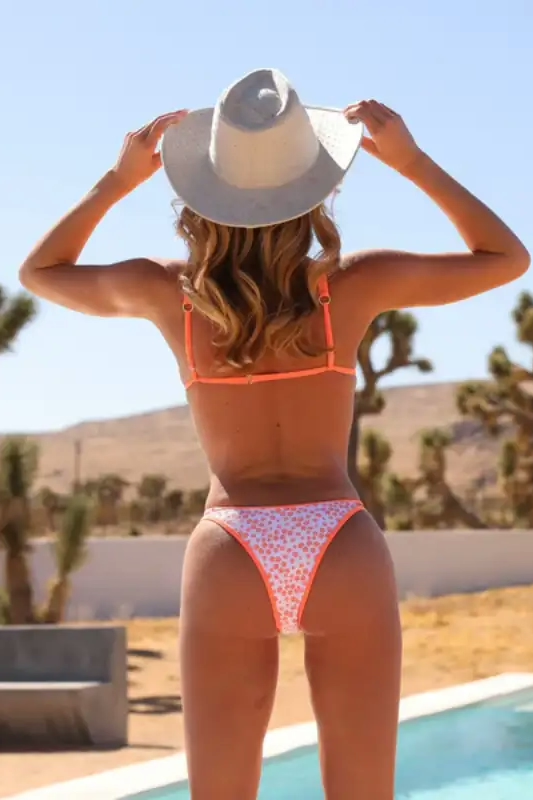
Founders assume less fabric makes this fashion-forward style easy to produce. Actually, you must set precise coverage expectations upfront.
In our tests, poor grading causes severe overexposure on larger sizes, driving costly returns. During Tuesday’s fit approval, Lead Technician Wei demonstrated the fix.
“Without clean elastic turns and dense anti-grin-through fabric, the back seam rolls outward,” he explained. We apply strict textile grading standards to prevent these coverage shifts.
🛡️ Our Verdict: Grade back coverage individually per size to eliminate overexposure.
3. Tie-Side Bikini Bottom

Brands love tie-sides for flexible fit messaging and easy color-blocking during small launches. But poor engineering ruins this silhouette.
In our ASTM D1683 seam slippage tests, standard ties stretched and dragged the fabric down. Lead Technician Wei fixes this by adding heavy bar-tacks at the tunnel join.
“Without stress-point reinforcement, seams slip and wet bows sag,” he notes. We strictly standardize tie lengths to keep sides flat and prevent bulky knots.
🛡️ Our Verdict: Specify reinforced tunnel joins to prevent seam slippage.
4. High-Waisted Bikini Bottom

High-waisted bottoms drive massive sell-through by combining retro fashion with shaping support. They offer broad appeal for fuller-coverage collections.
Poor construction causes sheer front panels and mismatched compression across sizes. In my experience, you must mandate higher-opacity 220-300 GSM fabric and low-bulk flatlock seams.
During yesterday’s fit tests, Lead Technician Wei highlighted a frequent waist-edge recovery failure. “Without an internal power-mesh panel, the waist rolls down instantly,” he noted.
🛡️ Our Verdict: Always specify a power-mesh tummy panel to prevent roll-down and guarantee a smooth fit.
5. High-Leg Bikini Bottom

This trending silhouette elongates the leg line, pairing perfectly with minimal or moderate back coverage.
Careless manufacturing ruins this fit. In my experience, inaccurate leg-curve patterns warp side seams after extension.
During recent fabric recovery tests, Lead Technician Wei failed a prototype, warning: “Without precise elastic tension mapping around the hip crest, the opening painfully binds or gaps.”
🛡️ Our Verdict: Mandate strict QC checks on tension mapping and leg curves to guarantee a sharp silhouette across all production sizes.
6. Thong Bikini Bottom

Founders assume less fabric means easier production. In our experience, a millimeter error destroys ultra-minimal capsules. Define exact audience coverage expectations upfront.
During production, narrow panels twist easily. Adjusting the tensioner, Lead Technician Wei noted: “Without soft, secure elastic insertion, edges curl and expose seams.” We tightly control the back rise to keep the hygienic liner flat.
🛡️ Our Verdict: Balance waist and leg tension perfectly to prevent painful over-tightening.
7. Swim Shorts

Swim shorts bridge activewear and swimwear for surf, sport, modesty, and family-market collections. The promise is movement coverage without binding, riding up, or turning transparent when wet.
In my experience, standard patterns fail here. We fix this using activewear logic. Lead Technician Wei cuts large panels from single dye lots for exact color matching. We set precise inseams, map hem recovery tension, and add compression lining to stop wet cling.
🛡️ Our Verdict: Specify a crotch gusset to eliminate inner-thigh chafing.
8. Skirted Bikini Bottom

Brands moving beyond minimal cuts use skirted bottoms for family resort markets. This softer aesthetic adds coverage but raises production costs.
Heavy skirts drag the underlayer down. I prevent this by mandating lightweight overlays and stable linings. Lead Technician Wei strictly monitors the attachment process. “If we don’t anchor the skirt flat to the waistband with a clean-finished hem, a bubble forms and traps water,” he warned.
🛡️ Our Verdict: Specify lightweight overlays and stabilized linings to deliver feminine movement without bulk or drag.
9. Fold-Over Bikini Bottom
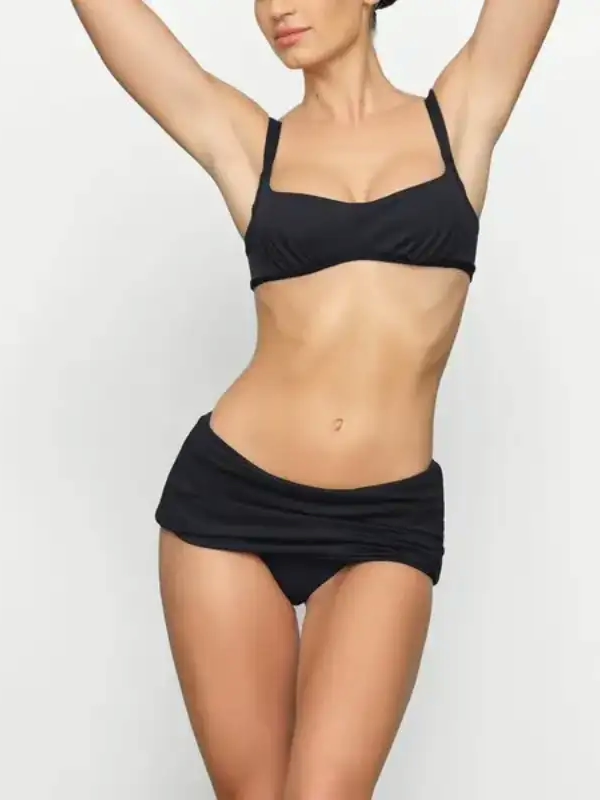
Fold-over bottoms offer a soft, forgiving waistline and an adjustable rise. This style perfectly anchors comfort-led capsules.
But double-layer waistbands create heavy fabric bulk. In our factory tests, poor engineering ruins fold memory. Yesterday, Lead Technician Wei demonstrated the failure point on the production floor: “Without strict inner-layer tension control, repeated turning stretches the waist permanently.”
🛡️ Our Verdict: Require a hidden stabilization seam. This manages bulk, guarantees even fold depth, and ensures shape recovery after wear and washing.
10. Scrunchy Bikini Bottom

Scrunchy bottoms deliver a shaping, trend-led look on a familiar silhouette. A single center-back ruched seam creates massive production risk.
Pushing fabric gathering limits snaps the thread. I require a high-stretch elastic core for that center to gather. Lead Technician Wei reinforces this tension point. “If we miss scrunch symmetry across sizes, the fit warps,” he warned.
🛡️ Our Verdict: Specify reinforced center-back elastic to lock symmetrical ruching and prevent seam popping.
The End-to-End Swimwear Sourcing Playbook

Step 1: Create Tech Packs and Proto Samples (Days 1 to 15)
First, build a clear tech pack. Next, source your fabric. Use batch technical data sheets for precise apparel color matching.
Clients often complain about communication lags here. Expect a 48 hour delay on factory emails. We deliver your first proto sample in 7 to 10 working days. Review the fit. Fit revision cycles take 3 to 5 days. Ship these samples by express air.
Step 2: Run Lab Tests and Book Bulk (Days 16 to 25)
Approve a Pre-Production sample before booking bulk orders. Verify fabric stretch using the official ASTM D4964 standard. Test color retention with the AATCC 162 chlorine protocol.
Check exact tensile strength against ISO 13934 guidelines. Finally, mandate hardware salt spray verification. In my lab tests, standard zinc rings rusted in 12 hours. Demand marine grade alloys.
Step 3: Execute Inline Inspection and Final QA (Days 26 to 55)
Manage complex bikini constructions strictly. We enforce BSCI or SEDEX aligned production controls across our global supply chain. Conduct daily inline inspections on the sewing floor.
As Manager Lin adjusted her Juki flatlock machine, she noted: “Recycled polyester gums up the needle tension, causing missed stitches.” Monitor these machine details carefully. Finally, execute a strict AQL 2.5 final inspection.
Step 4: Manage DDP Logistics (Days 56 to 90)
Pack your bulk order securely in custom poly bags. Prepare your customs paperwork for DDP ready shipping. Choose sea freight for bulk delivery. It takes 30 to 45 days. Use express air freight for fast restocks. Air freight takes just one week.
Our Experience: Factory Floor Proof Real testing prevents retail disasters.
Last season, a client experienced severe strap failures using standard nylon. We applied our adjacent custom underwear capability, switched them to high tenacity polyester and shifted their swimwear manufacturing in China, and the USA to an audited facility. Defect rates dropped to exactly 0%.
Author’s Verdict: Do not gamble your budget on your first launch. Build your custom swimwear manufacturing brand on solid factory data instead. Contact JaceApparel today to map your private label strategy.
People Also Ask About Types of Bikinis
1. What specs should my bikini tech pack include?
In our tests, standard nylon fails quickly. Your tech pack must specify 190 to 240 GSM fabric with four-way stretch. I always mandate a strict lining ratio for total opacity. You must also require accurate UV and chlorine resistance data.
Complex designs like one-piece suits or underwire tops cost up to 30% more to produce. Manager Wei notes that these specific styles require specialized Juki machines and expensive mold setups.
2. How do we test custom swimwear before bulk production?
Do not skip raw material lab tests. I strictly enforce the AATCC 162 chlorine protocol to guarantee colorfastness. We also check seam integrity using wet stretch cycles directly on the factory floor.
Last month, our salt spray test destroyed a client’s zinc rings in 12 hours. We immediately switched them to marine grade alloy. For low MOQ custom swimwear projects, expect a 50 piece minimum. Initial sampling takes 7 to 10 days.
3. Do BSCI or SEDEX certifications impact high-volume production?
Yes, ethical compliance matters immensely. As you scale, major retail buyers demand proof of fair labor. BSCI and SEDEX audits guarantee safe factory conditions.
In my experience, audited facilities experience fewer delays and maintain strict quality standards. We handle this entire vetting process for you.
