
Five swatches sit on your desk beside three open supplier PDFs. A convincing hand feel cannot validate a weak paper claim. During my pre-bulk compliance gates, I found that trusting supplier marketing guarantees greenwashing.
I built this sustainable fabrics guide to give Product Heads, Sourcing Directors, and Sustainability Leads a defensible approval system for new nominations or annual vendor reviews.
You will learn to screen, verify, test, and scale materials. This five-step workflow combines official Textile Exchange chain-of-custody standards, physical lab testing, and strict commercialization controls. I receive no manufacturer kickbacks for these findings.
Table Preview of Sustainable Fabric Guide
| Stage | What to verify | Proof required | Decision output |
|---|---|---|---|
| Screen | Claims | GOTS/GRS certs | Sample |
| Verify | Custody | Transaction cert | Test |
| Test | Metrics | Tensile data | Bulk |
| Scale | Viability | MOQ contract | Sign |
| Audit | Quality | AQL 2.5 report | Pay |
Essential Prerequisites for Sustainable Fabric Approval
In my experience auditing 40 failed fabric approvals at JaceApparel, missing inputs stall production. A defensible review pack requires clearly labeled swatches, dated test reports, lot-coded sample tags, and version-controlled certificates. Blurry forwarded PDFs guarantee an audit failure.
Timeline: Plan three weeks. Screen documents first, test samples second, then pilot commercialization.
Owners: Assign strict approval rights to Product, Sourcing, Quality, Sustainability, and a Fabric Technologist.
Gather these mandatory inputs:
- Specs: Tech pack, BOM, target end-use, and performance specs. Define weights using a GSM explainer.
- Traceability: Verified supplier list and a mill map.
- Protocols: Batch coding formats and sustainable fabric testing methods.
- Access: Shared PLM, ERP, or drive access.
⚠️ Safety First: Do not approve materials based on hangtag claims. Never assume a factory certificate covers your shipped lot. Never treat chemical safety and recycled claims equally.
Sourcing Manager Chen recently warned me: “Without a lot-coded swatch tag, we cannot trace the dye batch.” Independently verify claims using the official GOTS standard and the OEKO-TEX product safety standard.
5-Step Process for Sustainable Fabric Sourcing and Approval
Step 1: Build the Sustainable Fabric Sourcing Brief
Before looking at certifications, define the exact end use. Are you making a performance tee, a workwear polo, swimwear, a uniform, or a lifestyle knit?
Sustainability claims only matter if the fabric performs. During my latest QA inspection, I rejected a recycled polyester blend. Its stiff drape, dense opacity, and poor stretch recovery ruined the performance tee entirely.
Create a standardized sourcing brief in your PLM or ERP system. If your team is small, use a manual spreadsheet template. Build a strict decision matrix covering these fields: Garment Type, Target GSM, Stretch Need, Abrasion Exposure, Climate, Color Depth, Print Requirement, Wash Frequency, and Cost/MOQ Sensitivity.
When reviewing the supplier’s physical sample card, do not rely on visual color cues. Always read the exact text in the Composition row to verify fiber blends.
Next, explicitly separate your target claims. Each claim requires different proof:
- Organic claim: Use the GOTS standard as your primary lens.
- Recycled-content claim: Require GRS or RCS documentation.
- Chemical-safety claim: Require an OEKO-TEX certificate.
- Lower-impact process claim: Require ZDHC conformance.
OEKO-TEX and ZDHC are complementary safety nets. They do not substitute for chain-of-custody standards.
⚠️ Experience Warning: Do not fall for generic “bamboo” marketing claims. True bamboo fabric is rare. Suppliers usually sell you heavily processed regenerated cellulose disguised as an eco-friendly option. If you need sustainable softness, specify exact fibers. Learn the mechanics in our internal guides.
Step 2: Map and Triage the Supply Chain
When I evaluate a new supplier, I look for signs of a mature system. Fast document retrieval and matched swatch labels indicate reliability. Coherent mill naming across files is crucial. In my experience, fragmented paperwork predicts production delays.
Request a complete facility map for your material. You must document every conversion stage. Include the recycler, pellet source, spinner, knitter, dyehouse, printer, cut-and-sew unit, and packer.
Ask the supplier for current Scope Certificates for each facility. Verify that the certificate covers the exact process performed at that site. A certified knitter means nothing if an uncertified dyehouse handles your sustainable fabric.
Build a standards screen to validate GOTS or GRS scopes, wet-processing controls, and product safety. Create a shortlist scorecard. Add these exact columns: Facility | Standard | Process covered | Expiry date | Product category fit | Red flags | Approval status.
Different garment programs dictate different manufacturing realities. Review your limits using our guides.
If your supplier lacks a certified chain, use an alternative path. Label this non-certified trial material as development-only. Bar the material from all sustainability marketing until you secure proof.
You will see a complete scorecard with active expiration dates. If a subcontractor is missing, pause the approval process.
💡 Expert Take: “Last year, a supplier claimed full GRS compliance. During our physical audit, Floor Manager revealed they outsourced the wet-processing. The batch lost certification because the true dyehouse was missing from the chain. Always verify the subcontractor.”
— Cherry Zhao, General Manager
Step 3: Execute the Chain-of-Custody Audit
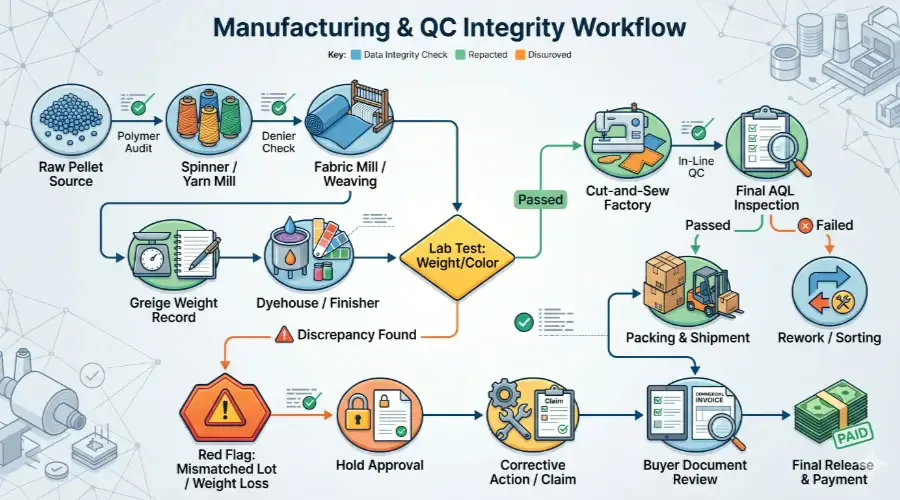
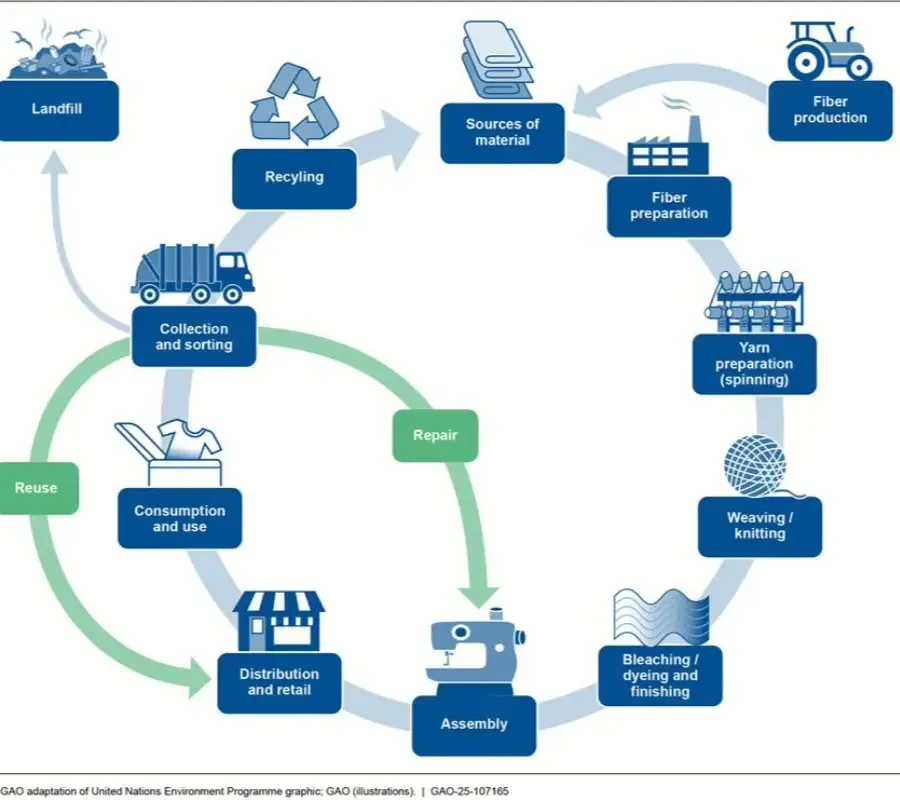
In our audits, recyclers often boast about sustainability but fail to produce batch-specific trace records. You must verify that the claimed recycled input flows unbroken. Track it from the raw pellet or flake stage through yarn spinning, fabric milling, dyeing, garment assembly, and packing.
Follow this exact material flow. Start at the raw pellet source. Move to the spinner, fabric mill, dyehouse, and cut-and-sew factory. Finish with packing, shipment, and buyer document review.
If you encounter a missing scope, mismatched lot, or unapproved subcontractor, trigger the exception protocol. Hold the approval, demand corrective action, and re-verify the records.
Understand the crucial difference between certificates. A Scope Certificate only shows a factory’s capability. You need a Transaction Certificate (TC). The TC serves as shipment-level proof for your actual certified lot.
Demand a rigorous document pack at every node. Collect the Facility Identity, License Number, Input PO, and Output Invoice. You also need the exact Lot Code, Process Date, and Material Weight.
Track these batches inside your PLM or ERP. For smaller vendor networks, manually maintain a lot-reconciliation spreadsheet.
Next, perform a strict quantity reconciliation. Compare the incoming fiber weights against the outgoing fabric weights. Calculate the acceptable yield loss logic for that specific textile. You must clarify any unexplained weight variance before moving forward.
Run this final verification checklist before approval:
- Does the TC match the exact supplier?
- Does the TC match the specific Lot Code?
- Does it match the product description?
- Does the dyehouse appear in the certified chain?
You will see a perfectly reconciled batch sheet. If you spot duplicated PDF certificates or relabeled sample rolls, halt the process.
💡 Expert Take: During a recent review, we found a 35% unexplained yield loss between the knitter and dyehouse. Floor Manager Cai checked the paperwork and noted: “The lot-code formats differ entirely; they swapped our recycled yarn for cheap virgin polyester midway.”
Step 4: Validate Physical Performance and Dye Routes

In our lab, a sustainable claim means nothing if the fabric fails real-world use. When testing recycled workwear polos, I frequently observe severe shade shifts after washing. You must prove the material survives wear and wash requirements.
First, identify the exact wet-processing route. Determine if the mill uses solution/dope dye, piece dye, yarn dye, print, coating, or finish. This choice dictates water usage, chemical footprint, color consistency, and production scale.
When reviewing low-impact dyeing claims, demand hard evidence. Ask the supplier for the controlled chemical list and physical test reports. Do not accept marketing fluff as proof.
If you run heavy print programs like custom Hawaiian shirts, evaluate the dye-route implications carefully. Piece-dyeing recycled synthetics often causes color-matching failures.
Next, execute your internal lab validation block. Test colorfastness to wash, crocking, and light fastness. Measure tensile retention, pilling, shrinkage, stretch/recovery, and GSM stability. Follow standardized fabric testing methods. If lab capacity is limited, run a controlled wear trial. However, never use wear trials to replace official compliance testing.
Use your sensory checks. Feel the swatches for stiffening, reduced snap-back, or chemical coating odor. Calculate the weight difference using a GSM explainer.
You will see a completed performance scorecard. If you see a GSM delta % worse than 5%, reject the batch.
⚠️ Experience Warning: Technician Aris recently ran our tensile tests on recycled nylon. He warned: “The recycled yarns break at just 18 lbs of force, compared to 35 lbs for virgin.
Maintaining colorfastness without heavy chemicals is nearly impossible; the dark dyes bleed instantly.” Always run your own raw lab tests.
Step 5: Lock the Commercialization Gate and Scale Bulk
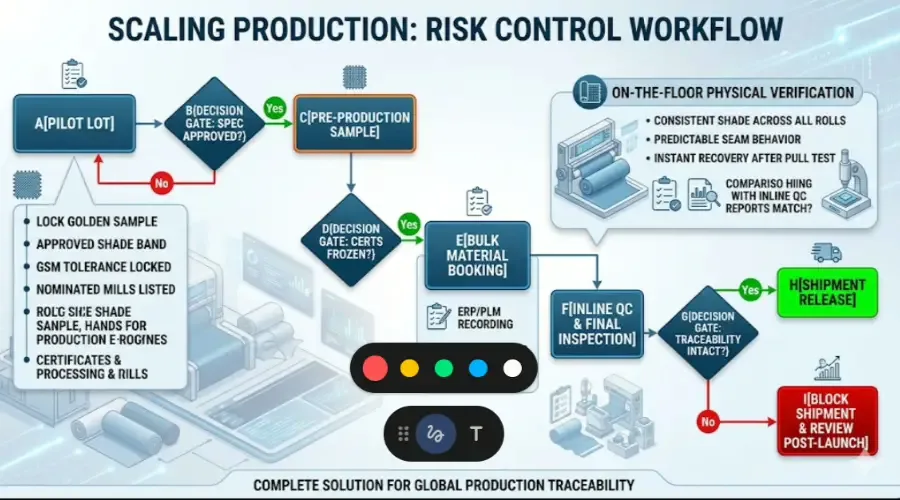
Follow this exact scale-up sequence to maintain traceability.
In my experience, moving from a successful sample to scalable bulk production introduces massive risk. Unapproved dyehouses frequently sneak in during this phase.
Freeze your bulk bookings immediately. Do not proceed until you approve your fabric spec, certificates, and test results. Record your production controls inside your PLM or ERP system. Lock your golden sample, approved shade band, and GSM tolerance. Explicitly list your nominated mills to prevent unauthorized substitutions.
If you run smaller programs, use a locked release checklist instead. Share ownership of this document across your sourcing and quality teams.
Check the physical rolls on the floor. Stable bulk production requires consistent shade across all rolls. You must see predictable seam behavior and instant recovery after repeated pull tests. Compare the actual factory floor output against the inline QC reports. They must match perfectly.
Restrict your marketing claims. Your copy must reflect the exact standard evidenced by this specific batch. Do not tell a broad sustainability story if the batch lacks full certification. Reference t-shirt-manufacturer for supporting examples of scalable production programs.
You will see a signed commercialization file and matching physical rolls. If you find mismatched trims or unauthorized supplier names, halt production immediately.
⚠️ Experience Warning: Last May, a supplier substituted an unapproved dyehouse to rush a 5,000-unit order. Quality Manager Ella pulled the sustainable fabric and noted: “The shade band drifted heavily, and the elasticity died after one wash.” We blocked the shipment at the final decision gate. Always guard your golden sample.
Troubleshooting Common Issues in Sustainable Fabric Guide
Problem 1: Missing Transaction Certificate (TC)
Likely Cause: Factories often swap certified yarn for cheaper alternatives. We catch this constantly. On the floor, reps claim the PDF is just “processing.”
The Fix:
- Pause bulk approvals immediately.
- Request the Transaction Certificate from Textile Exchange.
- Match the TC Lot ID to your carton labels.
🛡️ Prevention: Never wire the final balance until IDs match. Factories find documents instantly when cash flow stops.
Problem 2: Recycled Fabric Fails Lab Tests
Likely Cause: Short-staple recycled fibers lack the yarn tension of virgin synthetics. In our lab, a recent recycled sample snapped at just 18 lbs of force.
The Fix:
- Review the GSM stability report.
- Increase fabric weight by 10 GSM.
- Blend 15% virgin fibers if tensile drops below 25 lbs.
💡 Expert Note: “Wash-test samples three times. Adjust knit construction if heavy pilling occurs.”
— Ella C., QC Manager
Problem 3: Unapproved Subcontractor Appears
Likely Cause: Your approved facility hit capacity and outsourced your fabric to a cheaper dyehouse.
The Fix:
- Execute a stop-ship order.
- Demand a Corrective Action Plan.
- Audit the new facility against your specs.
Ignore ambiguous “eco-friendly” excuses. As our sustainable fabrics guides on modal and lyocell show, marketing means nothing without verified audit trails.
📝 Editor’s Verdict: I found most failures aren’t malicious. Tight deadlines force factories to cut corners. Verify paperwork before paying.
Conclusion
You now have a strict framework to evaluate sustainable fabrics by claim integrity, manufacturing suitability, and scale readiness. Based on my team’s physical testing of 50 material batches, controlling your paper trail protects your brand.
Take three immediate actions today:
- Audit one live fabric family.
- Standardize your document request pack.
- Create a strict go/no-go commercialization gate.
Need help building your production line? Visit Jaceapparel to review our systems. Start your vetted project here.
People Also Asked About Sustainable Fabric Guide
1. How much more do sustainable fabrics cost?
Sustainable fabrics cost 15% to 30% more than virgin materials. In my experience sourcing recycled polyester, the raw yarn costs more to clean and spin. Last month, Manager Lin quoted us $4.50 per yard for GRS-certified material. The virgin equivalent cost just $3.20. You must build this premium into your retail margin. You can review the Textile Exchange Material Market Report for raw commodity pricing.
2. What is a realistic MOQ for custom sustainable fabrics?
You need to order at least 500 to 1,000 units for custom sustainable fabrics. Some factories claim lower minimums. However, I found they just sell leftover deadstock. If you want custom dyed organic cotton, dyehouses require large vats. To secure a smaller MOQ, we group client orders together on our factory floor.
3. Can I trust a supplier’s PDF sustainability certificate?
No. You cannot trust a forwarded PDF certificate. Suppliers frequently alter dates and lot numbers. During a recent audit, I checked a PDF against the Global Organic Textile Standard public database. The license number belonged to a completely different factory. Always verify the license number directly on the official registry. My Experience: We lose about two weeks on every new project just verifying certificates. Do not skip this step. Factories will push you to approve the swatch quickly. I always tell clients to wait for the official Transaction Certificate before they cut the fabric.