
| Metric | Detail |
|---|---|
| 100 | Units in the trial |
| 30 | Industrial laundry cycles before sign-off |
| 1.5 | Lot-to-lot print variation (ΔE, before washing) |
Figures come from the pilot’s QC logs and costing sheet. The tests were run in-house; they are not third-party certification.
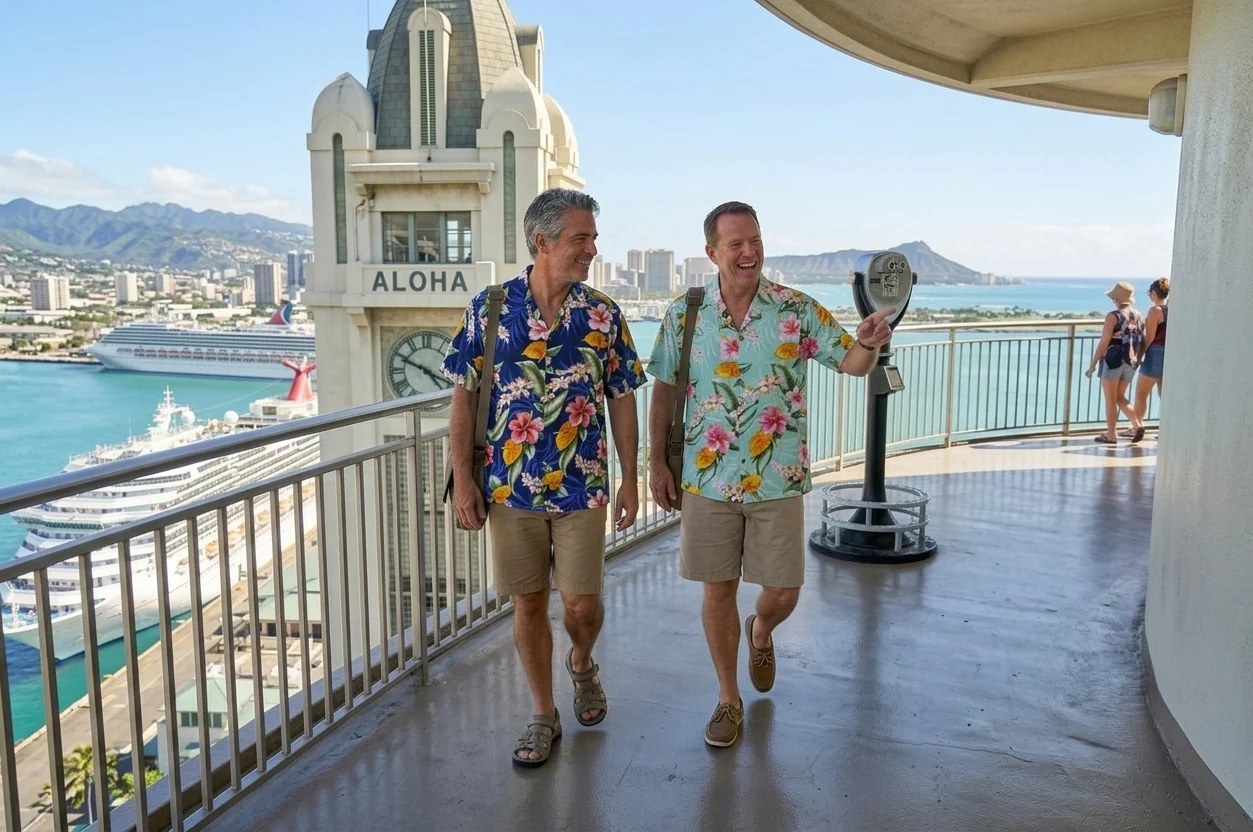
Azure Beach Resort in Australia needed to know whether a full-print uniform could survive its own property before ordering at scale. The lobby, the pool decks and the outdoor bars each wear a garment differently, and the tropical print had to hold from the front desk to the beach bar.
Isla Campbell asked to see the print on site before the order went past a single colour.
What follows covers the wear conditions the pilot had to answer, the test sequence built around them, and what the resort received.
At a Glance
| Item | Detail |
|---|---|
| Property | Azure Beach Resort, Australia, a coastal venue with three guest-facing zones, a multi-property plan and a peak-season calendar |
| The trial | One colour, XS to 3XL |
| The minimum | 100 pcs per colour, full-print included |
| The range | Full-print tropical uniforms, with a tested role for each blend |
| Scope | Fabric trials, strike-offs, CAD panel nesting, flatbed sublimation, pilot sewing, inline QC |
| The goal | A spec the board could take to a multi-property decision |
The Challenge
Six risks sat between the resort and a bulk order:
- Chlorine and salt. Poolside staff meet splash and salt-laden air, and each one attacks a fibre differently.
- Coastal UV. Outdoor crews work under sun that fades print over a season rather than in a single wash.
- Commercial laundry. Repeated industrial cycles test shrinkage and colour together, on the same garment.
- Brand continuity at the seams. Panel-to-panel alignment decides whether the print reads cheap at the join.
- Sizes from XS to 3XL. Borders and motif landmarks distort when one drawing is stretched across that range.
- Minimums that assume the print is proven. Full-print programmes commonly start at hundreds of pieces per colour, so a trial becomes an inventory commitment before anyone has seen it on site.
The concern sat on a budget line, a fixed seasonal date and a guest-facing brand promise. Once the print failed on site, it would be lived with for a season, not corrected in a week.
What they had in common. None of these was a sewing problem. Each was a decision that could be settled before cloth was cut — and each got more expensive once it was not.
Each zone put a different question to the same uniform:
| Zone | What the garment meets | Failure it exposes |
|---|---|---|
| Front desk | Indoor air, repeated washing | Fading and seam drift |
| Pool deck | Chlorine, salt, humidity | Colour shift and stiffening |
| Outdoor bar | Sun, humidity, heat | UV fading and poor breathability |
One washed set per zone answers those questions before volume does. Fabric tests that leave out chlorine or UV only answer half of them.
Our Solution
The pilot ran as one sequence. Each stage closed a risk before the next one opened:
- One spec per zone. Each team’s garment was defined before cutting, because each team wears it under different conditions.
- Single trial colour. The run started at the 100-piece minimum — the same minimum as a plain garment — so the print was proven before a second colour was committed.
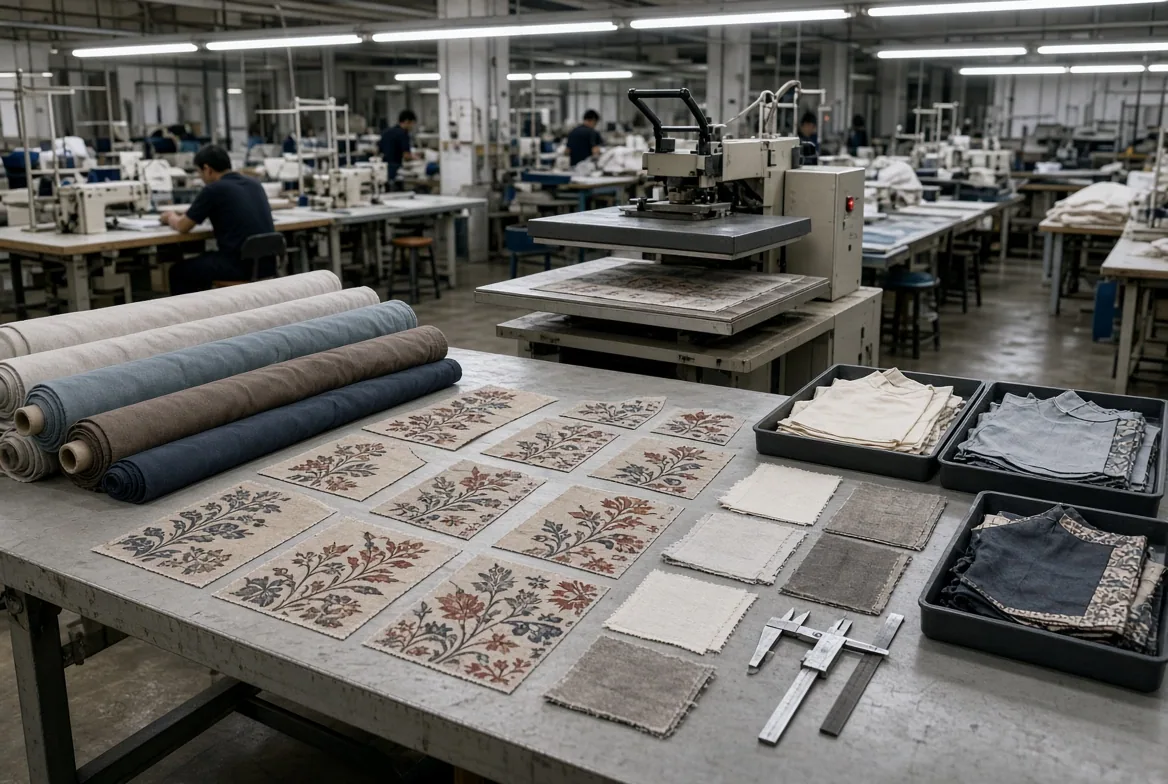
- Strike-offs before any sewing. Every shortlisted fabric was printed on its own greige, so colour drift surfaced in a day rather than after a bulk run.
- Grading built around the motif. Scaling one drawing across the size run distorts borders at the seam, so each size got its own placement.
- Print method chosen by volume. Flatbed sublimation carried a short run; rotary screen carried a setup cost this volume could not absorb.
- Shrinkage handled before the press. Fabric was stabilised before cutting, so the print could not distort in the heat transfer.
- Board-ready evidence. The run finished with a measurement table, wash data and an AQL gate the board could read.
Choosing Fabric by Role
Three fabric types were shortlisted, and each was given a job rather than ranked outright:
- 88/12 poly-spandex at the pool. Measured at 15% elongation and checked over ten recovery cycles, it holds shape for staff who kneel and reach.
- 100% micro-polyester at the front desk. Disperse dye takes thin lines and gradients sharply, which keeps the print legible from two metres.
- 60/40 Tencel-poly where drape leads. Softer in the hand and better at moving moisture, at the cost of about half a shade of print saturation.
Strike-offs and sewn prototypes answer different questions. The strike-off prints on the actual greige and catches colour drift in a day. Wear-testing catches what washing does to the construction. Skipping either costs more than doing both.
“Strike-offs cost me a day each. Skipping them costs a week.”
— Priya Raman, Textile Printing Engineer
Engineering the Print Across the Size Run
Full-print panel garments cannot be graded by enlarging the artwork with the pattern. The motif drifts at the seam, and the drift only appears after sewing.
Marcus Ye, the lead pattern maker, mapped the artwork onto each pattern piece in CAD before cutting. He graded the pattern from XS to 3XL against ISO 8559 size designations, then re-anchored motif coordinates to every graded panel.
The result was positional rather than approximate. That palm frond sat 12 mm from the side seam on size S and 12 mm from the seam on 3XL.
Nesting protected the budget as well as the design. Rotating and interlocking panels so neighbours shared print zones cut fabric use by about 11% per unit.
Why Sublimation Suited a Short Run
Rotary screen printing pushes ink through a cylindrical mesh screen onto a fabric roll. Flatbed sublimation prints to paper first, then heat-presses that paper onto cut panels.
- Rotary wins on yardage. Long continuous runs suit it, and its cylinder and setup cost is spread across them.
- Flatbed wins on a pilot. Setup finished in a morning, and the first printed panels came off the bed that afternoon.
- Colour has to be fixed, not re-invented. Every panel ran through one RIP workflow and the same ICC profile and ink limits, so the print stayed consistent across pieces.
For 100 units and twelve pattern pieces per garment, flatbed was the shorter and cheaper route. Above roughly 400 units per design, rotary setup amortises and the advantage reverses.
Calibrating Heat and Pressure
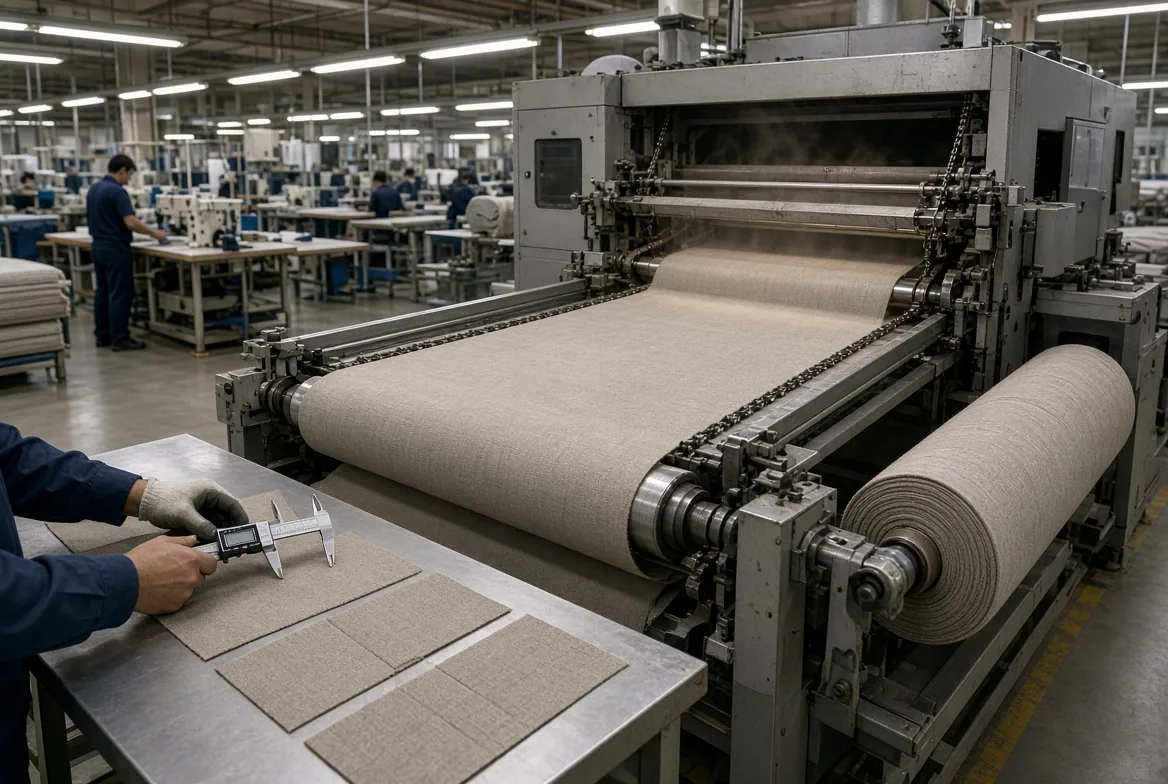
Three faults surfaced in the sample room: shrinkage distortion in the press, ghosting at seam joins, and poor breathability on the pool prototype.
“The polyester moved 4.1% after the first press. That is enough to pull a border off its seam line.”
— Marcus Ye, Lead Pattern Maker
- Shrinkage. Pre-heat-setting the fabric at 180°C on a stenter pulled residual movement under 1% before cutting.
- Ghosting. The cause was surface moisture, not pressure. Fifteen seconds of pre-press at 150°C drove it off.
- Registration. The transfer press ran at 195°C for 40 seconds at 3.2 bar, with a 6 mm bleed into each seam allowance.
- Breathability. The pool attendant back panel moved to a 150 gsm micro-poly mesh, checked against ISO 11092 thermal-resistance benchmarks.
The pressure ceiling. Above 4 bar the print gets sharper, but the hand feel flattens on lightweight knits. For a resort uniform, 3.2 bar was the practical limit.
Running the Pilot
The approved sample went into production as a 100-piece run.
- Inline checks at cut, print and sew. Tolerances held at ±1.0 cm on chest and waist, and ±0.5 cm on the collar.
- Shade control on every lot. Spectrophotometer readings held each printed lot at ΔE 1.5 or lower, and the colour matching record travelled with the order.
- Seam joins reviewed in natural light. Sewing teams checked registration at every join, plus labels, hang tags and packaging against the approved spec.
- Final inspection to AQL 2.5. The same gate applied to cut-and-sew programs of any size.
- Evidence, not just garments. Wash data, shrinkage figures, seam photos and measurement tables went to the resort as one record.
How the Pilot Was Tested
Each row answers a question the resort needed settled before a second colour:
| Test | Reference | What it measured |
|---|---|---|
| Print consistency | Spectrophotometer (ΔE) | Agreement between runs, capped at 1.5 |
| Machine washing | ISO 105 family | Shade and dimensional change over repeated cycles |
| Sunlight and pool water | AATCC TM16; ISO 105 family | Print fading and surface breakdown |
| Elastic recovery | Cycled extension | How the knit returns to shape |
| Heat and moisture transfer | ISO 11092 | Comfort under poolside conditions |
| Fit and workmanship | Inline and final QC | Graded measurements and the AQL gate |
Results
The pilot gave the resort a decision-ready scorecard in six weeks. After 30 industrial laundry cycles and 50 hours of simulated UV and chlorine exposure, the three blends ranked like this:
| Fabric blend | Colour shift after 30 washes (ΔE) | Print sharpness | Shrinkage | Stretch recovery | Hand-feel (1–5) | Best role |
|---|---|---|---|---|---|---|
| 88/12 poly-spandex | 1.4 | 92% | 0.6% | 96% | 3.8 | Poolside |
| 100% micro-polyester | 1.6 | 94% | 0.8% | Not tested | 3.5 | Front desk, outdoor bar |
| 60/40 Tencel-poly | 2.9 | 86% | 1.1% | 88% | 4.6 | Drape-first roles |
Two ΔE figures run through this write-up: lot-to-lot print variation, held at 1.5 or lower before washing, and the change measured after the 30-cycle wash test in this table. Wash shift under 2.0 is hard to see across a season. Poly-spandex took the pool because recovery matters more there than softness; Tencel-poly kept its hand but lost print crispness.
The UV work followed AATCC TM16 colour-fastness methods, and the wash and chlorine work followed the ISO 105 colour-fastness family. Those are method references, not certificates — the results remain internal test data.
The cost teardown explained the short-run economics. The figures below are indicative print cost per garment, in USD, and they compare methods rather than set order minimums.
| Volume (units) | Digital sublimation | Rotary screen | Digital advantage |
|---|---|---|---|
| 50 | $38.40 | $61.90 | −$23.50 |
| 100 | $31.20 | $46.40 | −$15.20 |
| 300 | $24.80 | $26.10 | −$1.30 |
At every volume tested, digital full-print avoided the cylinder and setup cost that rotary carries. At 300 units the gap narrowed to $1.30, so method choice should follow rollout volume rather than preference. The full logic sits in the garment costing guide.
The resort later placed a repeat order ahead of peak tourist season, on the spec the pilot fixed.
The pilot also settled the working spec:
- Wet zones switched to the stretch blend.
- Front desk stayed on the print-crisp blend.
- Approval limits for the wet-zone and front-desk blends were colour shift at ΔE 2.0 or lower, shrinkage under 1.0%, seam registration across XS to 3XL, and AQL 2.5 at final inspection. Tencel-poly measured outside both numeric limits (2.9 ΔE, 1.1%) and stayed limited to drape-first roles.
- Private-label finishing and packaging review moved into the rollout brief, with private-label capacity reserved for the next volume.
In the Client’s Words
“We wanted to refresh our beach resort staff uniforms but were nervous to commit to hundreds of pieces without seeing how the new print would work on-site. The 100-pcs-per-colour MOQ let us run a controlled trial batch first. The colour rendering and fabric quality were better than we expected, and the staff were happy with the fit. We later placed a repeat order ahead of peak tourist season.”
— Isla Campbell, Procurement Manager, Azure Beach Resort
Who This Order Model Suits
Hospitality groups fit this pattern when they:
- Operate several zones with different wear conditions
- Want a branded print rather than a stock garment
- Dress staff across the full range of body sizes
- Approve a pilot before committing to a wider order
- Need evidence for a board, an owner or a group procurement team
Vetting a Resort Uniform Trial Run
The pilot is decided in the brief, not on the factory floor:
- Name each zone and the conditions its garment actually faces — chlorine, sun, heat, laundry.
- Ask for a shortlist that explains what each fabric is for, not one recommendation.
- Require print samples on the actual fabric, and a CAD proof of motif placement for every size.
- Write the pass/fail rule before approving the sample, so the pilot reports a decision rather than an impression.
- Confirm the print method, the point at which it changes, and the colour minimum.
- Decide what the pilot must hand over — figures, photographs and a size-by-size record.
Starting with uniform manufacturers is one route; starting with the pilot is the one that answers a board. If a resort rollout is already on the calendar, send the brief through the contact page and we will confirm what a trial run can hold.